 Log in


Why "Low Acid" Isn't Just pH: Chlorogenic Acids, Roasting, and What the Lab Found
By Alex Brecher
Share
I get a version of this email every week: "Your coffee says low acid, but I measured the pH with my own strips and it's barely different from my old brand. What gives?" It's a fair question, and the answer is the thing I wish every low-acid coffee company would explain. pH is real, but it's not the part that matters most for your stomach.
Two different things people mean by "acid"
When a coffee taster says a coffee is acidic, they mean bright. That citrusy snap in a light roast. It's a compliment.
When a customer tells me a coffee is acidic, they mean it burned. Heartburn by 10 a.m., or reflux that night. That's the one we built this company around.
pH measures total acidity. Most brewed coffee sits somewhere around 4.8 to 5.1, which is mildly acidic, in the same neighborhood as tomato juice. The trouble is that pH tells you how much acid is in the cup, not which acids. And the which turns out to matter a lot.
The compound that causes the trouble
Green coffee beans are full of chlorogenic acids, usually shortened to CGAs. They're antioxidants, which is nice, but they are also one of the main reasons coffee tastes bitter and one of the main reasons it gives people reflux. Dr. Takayuki Shibamoto, a professor of environmental toxicology at UC Davis, has written about CGAs as a source of both problems, and his work is a big part of why we roast the way we do.
Roasting breaks CGAs down. How many survive into your cup depends on three things: which bean you start with, how you roast it, and how you finish the roast.
Start with Arabica
Arabica beans carry less chlorogenic acid than Robusta, and less caffeine. The big cans at the supermarket are usually blended with Robusta because it's cheaper, and that's the coffee most people with a sensitive stomach gave up on. Everything we roast is 100% certified organic Arabica. Right now that's coffee from Chiapas in Mexico, Huehuetenango in Guatemala, Honduras and Nicaragua.
Roast with air, not a hot drum
Almost every roaster in the country uses a drum roaster. The beans tumble around inside a rotating steel drum that's hot enough to scorch, so the outside of the bean cooks faster than the inside. CGAs near the surface break down. The ones in the middle don't.
We use a hot-air roaster. The beans float on a column of superheated air and never touch metal. Every bean heats evenly from the skin to the core, so the CGAs break down all the way through, and you don't get the scorched, bitter notes that come from the drum.
Finish slow and a little cooler
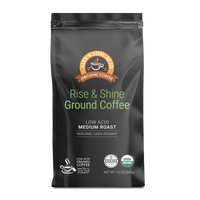
Here's the part Jon, our roaster, is proudest of. Darker roasts have fewer CGAs because they've been in the heat longer, but if you just crank the roast darker you end up with coffee that tastes like a campfire. So Jon stretches out the last stage of every roast at a lower temperature. It keeps breaking CGAs down without pushing the beans past where they taste good. That's how Rise & Shine, which is a medium roast, still tests as low acid.
What the lab found
I don't want you to take my word for any of this, so we send all four roasts to Genista Biosciences, an independent lab, and we publish the whole report on our lab results page. From that report:
| Roast | pH | Chlorogenic acids |
|---|---|---|
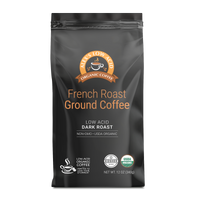
| French Roast | 5.77 | 210.8 ppm |
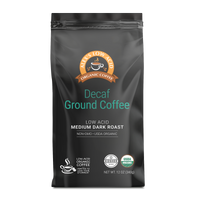
| Decaf | 5.58 | 243.0 ppm |
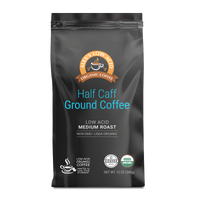
| Half Caff | 5.46 | 242.0 ppm |
| Rise & Shine | 5.40 | 290.7 ppm |
Higher pH is less acidic, so 5.4 to 5.8 is a real step up from the 4.8 to 5.1 you'd get from a typical pot. The CGA column is the one I'd pay attention to, though. French Roast comes in lowest, which is why it's the one I usually recommend to people with reflux. And in an earlier round of testing against other low-acid Arabica coffees, ours came in up to 25% lower in CGAs.
The same report screened for more than 600 pesticides plus glyphosate (none found), five mycotoxins (none found), yeast and mold, heavy metals, E. coli and Salmonella. I mention that because a coffee that's low acid but moldy isn't going to do your stomach any favors either.
What it doesn't mean
Low acid isn't acid-free. All coffee has some acid. Ours has less.
It doesn't mean less caffeine. French Roast and Rise & Shine are fully caffeinated. If caffeine is your trigger, that's what Half Caff and Decaf are for.
And I can't promise you'll never get heartburn. Thousands of customers tell us they can drink coffee again, and I believe them, but everyone's different. Have one cup and see how you feel.
Questions we get
Does dark roast have less acid than light roast? Usually, yes. More time in the heat means more CGAs break down. But the roasting method matters just as much, which is why a drum-roasted dark roast can still bother you.
Is cold brew lower in acid? Cold water pulls out fewer acids, so it tastes smoother. It also pulls out more caffeine over that long steep, which is the opposite of what most of our customers want. A low-acid bean brewed hot gets you the smooth cup without the extra caffeine.
Is organic coffee lower in acid? Not by itself. Organic is about how the coffee was grown. Low acid is about how it was roasted. We do both, and we test for both.
How do I know a "low acid" coffee is really low acid? Ask for the lab report. If a company can't show you a pH or CGA number from an independent lab, "low acid" is a flavor description, not a measurement.
If you want to go deeper, Jon walks through the roast itself in this Q&A, and the full lab report is here.
