 Log in


How to Choose a Low Acid Coffee: A Buyer's Checklist for Sensitive Stomachs
By Alex Brecher
Share
"Low acid" isn't a regulated term. Nobody checks. Any roaster can print it on a bag, and plenty do, which is how a lot of our customers ended up buying three or four "stomach-friendly" coffees before they found one that actually was. So here's the list I'd use if I were shopping for low-acid coffee and didn't already own a coffee company. It works on any brand, ours included.
1. Make sure it's 100% Arabica
Arabica beans have less chlorogenic acid and less caffeine than Robusta. If the bag says 100% Arabica, good. If it doesn't say, assume there's Robusta in there, because Robusta is cheaper and nobody leaves it off the label by accident. The big supermarket cans are mostly Robusta blends, and they're usually the coffee people were drinking when the heartburn started.
2. Ask how it was roasted, not just how dark
Dark roasts generally have fewer of the acids that bother your stomach, because longer roasting breaks them down. But the method matters as much as the color. Most roasters use a drum, which is a hot steel cylinder the beans tumble against, so the outside of each bean cooks faster than the inside. Hot-air roasting, which is what we do, heats every bean evenly all the way through, so more of the acid breaks down and nothing gets scorched. That's why our medium roast tests as low acid and a lot of drum-roasted dark roasts don't.
One more thing to watch for. Some brands get their "low acid" from an alkaline wash or a mineral powder added after roasting. That can move the surface pH, but the chlorogenic acid inside the bean is still there. If the low acid comes from an additive instead of the roast, ask what was added.
3. Look for a lab report with actual numbers
This is the one that separates the real thing from the marketing. A real report names the lab and lists a pH for each roast. The good ones also list chlorogenic acid. Ours is from Genista Biosciences, and it's on our lab results page: pH between 5.40 and 5.77 across four roasts, chlorogenic acid between 210.8 and 290.7 ppm, and screens for pesticides, mycotoxins, heavy metals and bacteria.
If a brand can't show you a report, "low acid" is an adjective, like "smooth." It might be true. You just have no way to know.
4. Organic, and tested for mold
Organic doesn't make coffee low acid. It does keep a long list of synthetic pesticides and herbicides out of your cup, and coffee is one of the most heavily sprayed crops on earth. Look for the USDA Organic seal. Then look for a separate mold and mycotoxin test, because green coffee that's been stored badly grows mold, and mold will upset your stomach just as reliably as acid.
5. Match the caffeine to what actually bothers you
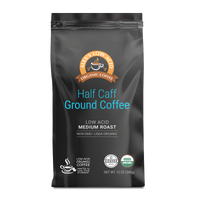
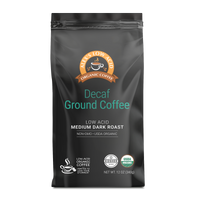
For some people it was never the acid. Caffeine relaxes the valve at the top of your stomach, and for those people a low-acid coffee helps a little and a decaf helps a lot. If low acid alone doesn't do it, step down. Our Half Caff has about 50 mg per cup, half a normal serving. Our Decaf uses the Mountain Water Process, which takes the caffeine out with water instead of solvents. Whatever brand you buy, check how the decaf was made.
6. Buy the format you'll actually use
The best low-acid coffee is the one you keep drinking. We make 12 oz bags, 5 lb bags for households and heavy drinkers, pods for Keurig-style brewers, and steep bags for travel and the office. It's the same coffee in every format, so the bag at home and the box in your carry-on are the same thing.
7. Check for a guarantee
Nobody honest will promise you zero heartburn. What they can do is let you try it without risk. Everything we sell has a 30-day guarantee, and you can buy a single steep bag for $1.99 if you want to try one cup before you commit to a bag.
The short version
- 100% Arabica
- Hot-air roasted, or at least a stated roasting method
- A lab report with pH and chlorogenic acid numbers
- USDA Organic and tested for mold
- A caffeine level that matches your trigger
- A format you'll use every day
- A guarantee
We check all seven, and we publish the proof. That's really the whole pitch.
Questions we get
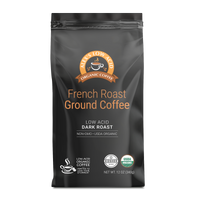
What's the best low-acid coffee for GERD? Among ours, French Roast had the lowest chlorogenic acid in testing, so that's where I'd start. If caffeine is also a trigger, go Decaf.
Does low acid mean less caffeine? No. Those are separate things. Low acid describes the acids. If you want less caffeine, buy half-caff or decaf.
I had bariatric surgery. What should I drink? Follow your surgical team's timeline first. When they clear coffee, most of the bariatric patients we hear from start with a small cup of low-acid decaf. We've written more about that here.
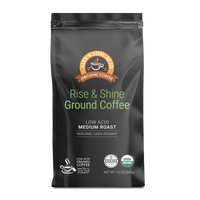
Not sure where to start with us? Rise & Shine Ground is the one most people try first, and the steep bags are the cheapest way to try a single cup.
